Pexlora
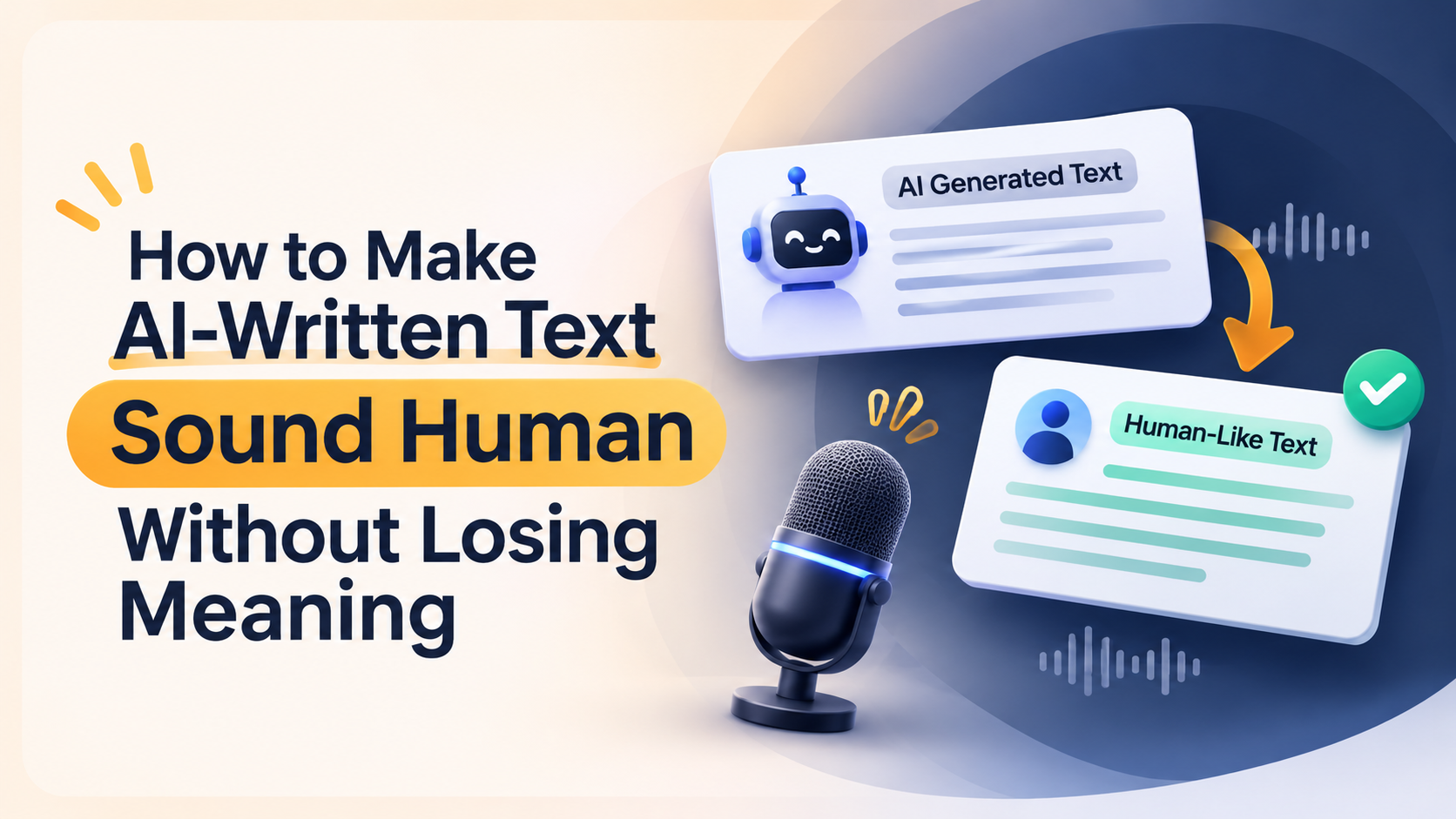
How to Make AI-Written Text Sound Human Without Losing Meaning
AI drafts often sound flat, padded and oddly formal. Learn the patterns that make text read as AI-written and how to edit a draft so it sounds like a real person, in your own voice.

5 min read
On this page
You asked an AI tool to draft an email, a product description or a blog intro. The facts are fine, but it reads like a brochure written by a committee. "In today's fast-paced world." "It's important to note." Three bullet points where one sentence would do. Readers notice, and it costs you their attention.
Learning to make AI text sound human isn't about tricking anyone. It's ordinary editing: cutting filler, adding specifics only you know, and putting the words back in your own voice. Done well, the result is clearer and more useful, whoever or whatever wrote the first draft.
This guide covers the patterns that make text feel machine-written, a step-by-step editing routine with before-and-after examples, and where tools like an AI humanizer help and where they don't.
A quick word on honesty
This guide is for improving drafts you're entitled to use: your own emails, marketing copy, internal documents and articles you take responsibility for. If your school, university, employer or publisher requires you to write something yourself, or to disclose AI use, follow that rule. Rewording AI output to pass it off as your own work where that's not allowed is a different thing entirely, and it isn't what this is for.
It's also worth knowing that AI detectors are unreliable in both directions. OpenAI withdrew its own text classifier in 2023, citing its low rate of accuracy. Our post on how accurate AI text detectors are covers the research. The goal here is better writing, not a detector score.
The patterns that make text sound like AI
Most "robotic" writing comes from a handful of habits. Once you can spot them, editing gets much faster.
- Throat-clearing openers. "In today's digital landscape" or "When it comes to" before getting to the point.
- Hedging filler. "It's important to note that", "It's worth mentioning", "Generally speaking".
- Inflated vocabulary. Words like delve, leverage, seamless, robust, elevate and unlock, used where plain words work better.
- Identical rhythm. Every sentence about the same length, every paragraph three sentences.
- Lists of three everywhere. "Fast, reliable and efficient." Real writing doesn't always come in threes.
- No specifics. General claims with no names, numbers, places or examples.
- A summary at the end that repeats what you just read.
An editing routine that works
Work through a draft in this order. Each pass is quick, and together they transform the text.
- Cut the first sentence. AI drafts usually warm up before saying anything. Deleting the opener often leaves a much stronger start.
- Delete filler phrases. Search for "important to note", "in order to", "it's worth" and "when it comes to". Most can go with no loss.
- Swap inflated words for plain ones. "Use" instead of "leverage", "help" instead of "empower", "look at" instead of "delve into".
- Add one real specific per paragraph. A number, a name, a place, a price, a short story. This is what AI can't supply because it doesn't know your situation.
- Vary sentence length. Break a long sentence in two. Join two short ones. Add a three-word sentence for emphasis.
- Read it aloud. If you wouldn't say it that way to a colleague, rewrite it until you would.
- Cut the ending summary. End on the most useful point instead.
Before and after
AI draft
In today's fast-paced digital world, it's important to note that image compression plays a crucial role in website performance. By leveraging modern formats, businesses can unlock seamless user experiences and elevate their online presence.
Edited
Our product pages took six seconds to load on a phone. Most of that was images. Switching them to WebP and resizing them to the size they actually display at cut the load time in half.
The edited version is shorter, specific and believable. It also sounds like a person who did something, because it describes something that happened.
Add what only you know
The single biggest upgrade is information the AI couldn't have. That's your experience, your data and your opinion.
- Experience: "We tried this with 40 customers in Indore" beats "Many businesses find this helpful".
- Data: Your own numbers, even rough ones, are more convincing than generic claims.
- Opinion: Say what you'd actually recommend and why. Readers trust a clear view more than a balanced list of everything.
- Local detail: Prices in rupees, Indian examples, references your readers recognise.
Google's own position, in its guidance on AI-generated content, focuses on whether content is helpful and original, regardless of how it was produced. Adding real experience is exactly what makes content worth ranking.
Where a humanizer tool helps, and where it doesn't
An AI humanizer rewrites text to smooth stiff phrasing and vary rhythm. The AI Humanizer also shows a score before and after, which is handy for spotting which passages still sound mechanical.
It's useful for a first pass on long drafts, for turning formal text more conversational, and for highlighting the stiffest sentences so you know where to focus. It can't add your experience, check your facts or know what your readers care about. Use it as a starting point, then edit by hand.
Always check a rewritten draft for meaning. Automated rewording can subtly change claims, drop qualifiers or soften something that needed to be precise, especially in legal, medical or financial text.
A worked example: a product description
A small Jaipur block-print brand asked an AI tool for a product description. It produced: "Elevate your wardrobe with this exquisite handcrafted kurta, seamlessly blending tradition and modernity for the discerning fashion enthusiast."
The owner edited it to: "Hand block-printed in Bagru using natural indigo. Soft mulmul cotton that gets softer with every wash. Straight cut, falls just below the knee. Each piece has small variations in the print, because a person made it, not a machine."
Every sentence now says something true and specific. That version sells better because customers can picture the product.
Frequently asked questions
Can people tell if text was written by AI?
Readers often notice generic phrasing and filler, even if they can't say why. Detectors are much less reliable and frequently misjudge human writing, especially by non-native English speakers.
Is it okay to use AI to write blog posts?
It can be, if you edit carefully, add real expertise and take responsibility for accuracy. Follow any disclosure rules that apply to your platform or industry.
What words make writing sound like AI?
Common giveaways include delve, leverage, seamless, robust, elevate, unlock, tapestry and "in today's world". Plain alternatives almost always read better.
Does a humanizer tool make text undetectable?
Don't rely on it for that. Its real value is improving readability. Where original work is required, write it yourself.
How long does it take to edit an AI draft properly?
For a 600-word piece, expect 15 to 20 minutes for a solid edit. Most of that time goes into adding specifics, which is also where most of the improvement comes from.
Try it on your next draft
Take one AI draft you've got lying around and give it just two passes: delete the first sentence of every paragraph, then add one specific detail to each. Compare the two versions side by side. The difference usually speaks for itself.