Pexlora
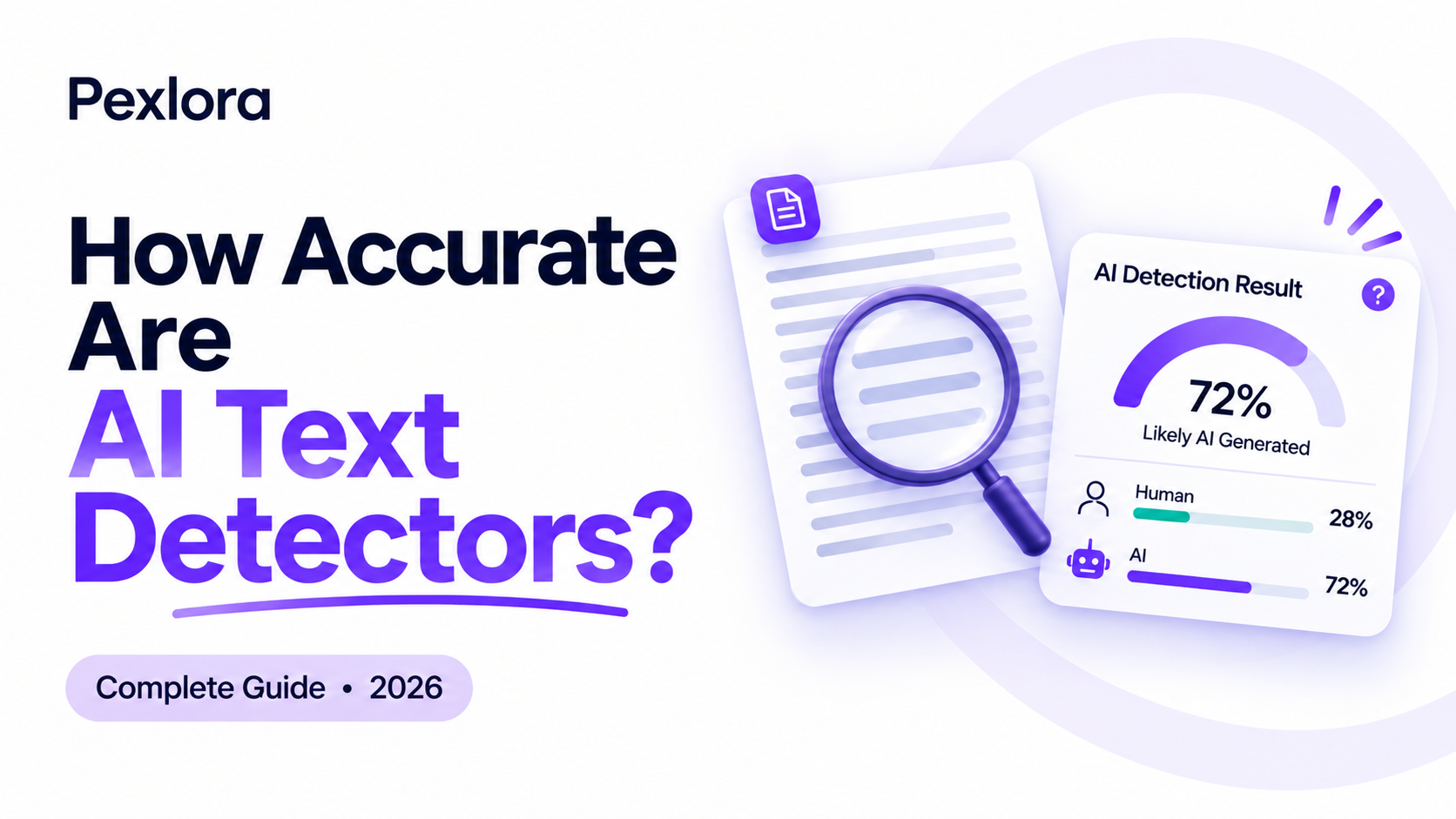
How Accurate Are AI Text Detectors? What the Evidence Shows
Are AI text detectors accurate? See what research and OpenAI's own results show about false positives, bias against non-native writers, and how to use detector scores responsibly.

6 min read
On this page
Teachers run essays through them, editors check freelance drafts with them, and students worry about being flagged by them. So are AI text detectors accurate? The short answer: they can spot obvious, unedited AI text reasonably often, but they make enough mistakes, in both directions, that a score on its own should never decide whether someone is accused of cheating.
The stakes are real. A false accusation can cost a student a grade or a freelancer a client, while missed AI text can slip into published work. Detection tools often market high accuracy figures, but the evidence from independent research and from AI companies themselves is more cautious.
This article explains how detectors work, what the research found, the situations where they fail most, and a practical way to use a detector score as one piece of evidence rather than a verdict.
How AI text detectors work
Most detectors are themselves machine learning models. They are trained on large sets of human-written and AI-written text and learn statistical differences between the two. Two signals come up often:
- Perplexity: how predictable each word is to a language model. AI text tends to choose likely words, so it reads as low-perplexity.
- Burstiness: how much sentence length and structure vary. Human writing often mixes short and long sentences more unevenly than AI output.
The output is a probability, such as "82 percent likely AI-generated". That number is a model's estimate based on patterns, not a record of how the text was actually produced. Nothing in plain text proves its origin the way a signed file can.
This design explains the main weakness. Any human who writes in a plain, predictable style, such as a careful non-native speaker or someone following a strict template, can look "AI-like" to the model. And AI text that has been lightly edited can look human.
What the research says about AI detector accuracy
Two well-documented findings frame the debate.
OpenAI's own classifier
In January 2023, OpenAI released a tool to flag AI-written text. On its own challenge set, OpenAI reported that the classifier caught only 26 percent of AI-written passages, and wrongly labelled human writing as AI 9 percent of the time. In July 2023 the company took the tool offline, citing its low accuracy.
The company that built ChatGPT could not make a detector reliable enough to keep online. That does not mean every current tool is equally weak, but it is a strong reason for caution.
Bias against non-native English writers
A Stanford study, GPT detectors are biased against non-native English writers, tested several popular detectors on essays by native and non-native English speakers. The detectors handled the native speakers' essays well but repeatedly mislabelled the non-native speakers' essays as AI-generated. The researchers also found that small prompting tweaks let AI text slip past the same detectors.
Put simply, the people most likely to be wrongly flagged are those writing in a second language, while people deliberately using AI can often evade detection with small changes.
Where AI detectors fail most often
Detector errors are not random. They cluster in predictable situations.
| Situation | Typical error | Why it happens |
|---|---|---|
| Short text under a few hundred words | Unreliable either way | Too little text for patterns to show |
| Non-native English writing | False positive | Simpler vocabulary reads as predictable |
| Formulaic writing such as lab reports or legal text | False positive | Templates reduce variation |
| AI text edited or paraphrased by a person | False negative | Edits break the statistical patterns |
| Text polished by grammar tools | Mixed results | Human ideas, machine-smoothed wording |
Mixed authorship is the hardest case of all. Many people now draft with AI and then rewrite, or write themselves and use AI to fix grammar. A single "AI or human" label does not describe that kind of work, and detectors often return a confident score anyway.
How to use an AI detector score responsibly
Detectors still have a place, as a screening tool. Used carefully, they help you decide where to look closer. Here is a process that keeps the score in proportion:
- Check length first: run only passages of several hundred words or more. Short answers produce noise.
- Read the score as a probability: 60 percent is close to a coin toss. Only very high scores on long text are worth following up.
- Look at what drove the score: if your detector highlights sentences, check whether they are genuinely generic or just plainly written. The Pexlora AI Text Detector gives an AI-likelihood score you can use as this first screen.
- Compare with known writing: a student's earlier essays or a writer's past articles are a better baseline than any model.
- Ask about the process: drafts, notes, version history in Google Docs, or a short discussion of the topic reveal far more than a score.
For a student, this might mean that a 90 percent score on a 1,500-word essay leads to a conversation about how they researched it, not a zero mark. For an editor, a high score on a freelance draft is a reason to check sources and ask for revisions, not to end the contract on the spot.
If your own writing gets flagged
Being falsely flagged is stressful, but there are practical steps that help.
- Keep your drafts: version history in Google Docs or Word shows your writing developing over time, which is strong evidence of authorship.
- Share your notes and sources: research notes, outlines and browser history support your account.
- Point to the research: the OpenAI and Stanford findings above are widely cited and show that false positives are a known problem.
- Offer to discuss the work: explaining your argument in your own words is persuasive in a way a score is not.
Avoid running genuine work through a "humanizer" just to beat a detector. It can change your meaning, and if the person reviewing your work compares versions, it can look worse than the original flag.
Frequently asked questions
Can AI detectors be 100 percent accurate?
No current detector is fully reliable. They estimate probability from writing patterns, so some human text will look AI-like and some AI text will look human. Claims of near-perfect accuracy usually come from tests on unedited text that does not reflect real use.
Why was my human-written essay flagged as AI?
Plain vocabulary, consistent sentence structure and formal templates can all look predictable to a detector. Non-native English writers are especially affected, as the Stanford research shows. Keep your drafts as evidence of your process.
Do teachers rely on AI detectors?
Some schools use them as a first screen, but many guidelines advise against using a score as the only evidence. A fair process combines the score with drafts, past work and a conversation with the student.
Is there a reliable way to prove text was written by AI?
Not from plain text alone. Provenance approaches, such as signing content at the point of creation, are more promising than pattern-based detection, but they are not yet widely used for text.
Your next step
If you review writing regularly, set a simple policy before the next flagged piece lands on your desk: minimum text length, the score threshold that triggers a follow-up, and the evidence you will ask for. Then use the AI Text Detector as the first screen in that process, not the last word.